The club
A short history of the Quatsch Comedy Club
From a Hamburg canteen stage in 1992 to television, awards and a cellar room in Berlin: what the sources say about the club.
Reserve your night ↗Quick answer
German Wikipedia says the Quatsch Comedy Club began in 1992 as a stand-up stage show created by Thomas Hermanns, with its origins in the canteen of the Deutsches Schauspielhaus in Hamburg. It reached pay television in 1993 and then free television on ProSieben, won a German Comedy Award in 1997 and again in 2000 for best comedy show, and moved into the basement of the Friedrichstadt-Palast in Berlin in the early 2000s. The claim to be Germany's first stand-up comedy club is the club's own.
Hamburg, 1992
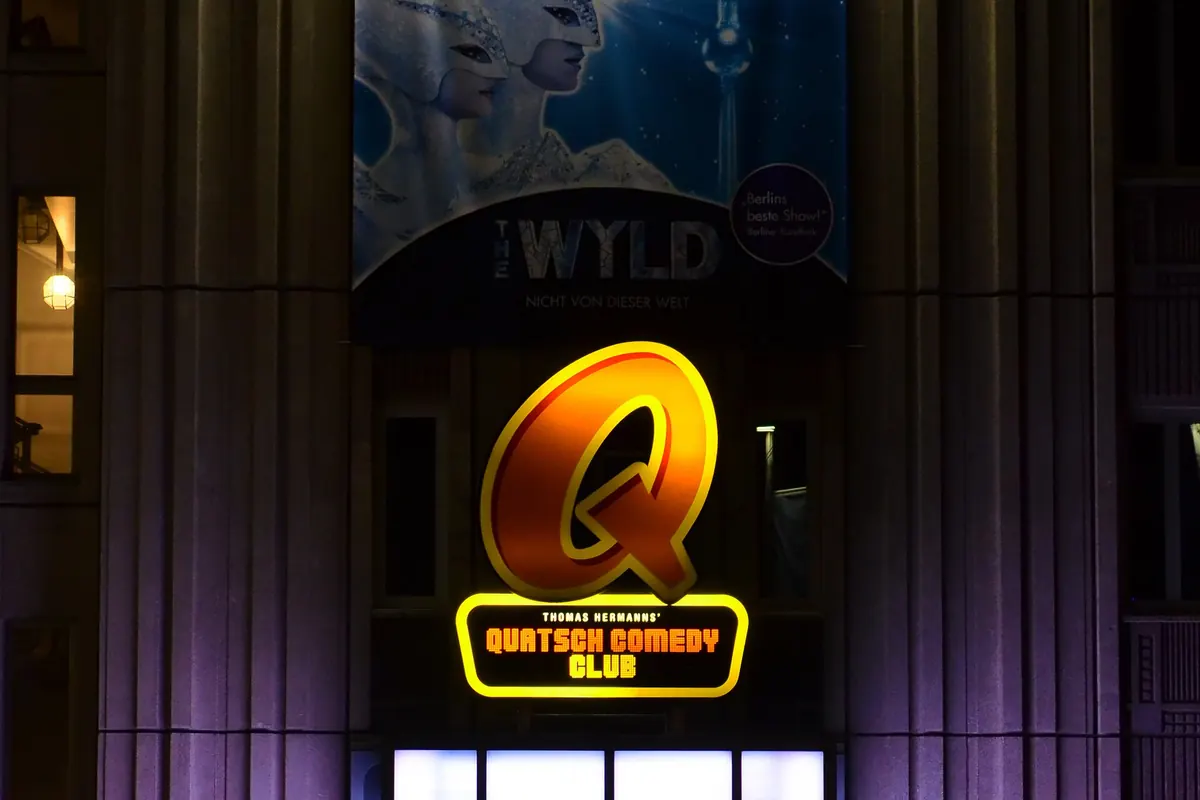
Both English and German Wikipedia date the beginning to 1992 and credit Thomas Hermanns. German Wikipedia adds that the show grew out of the canteen of the Deutsches Schauspielhaus in Hamburg and that its long-time home was the Imperial Theater on the Reeperbahn. That puts the club's roots in a working theatre rather than a purpose-built comedy venue, which fits the informal feel of the genre.
Television
German Wikipedia says the stage show was broadcast on the pay channel Premiere from 1993 and reached free television on ProSieben, with English Wikipedia placing the start on ProSieben in 1996 and German Wikipedia giving March 1997 in its infobox. Because the sources disagree by a year, this guide leaves the exact start open. Either way, television turned a Hamburg stage show into a national name.
Awards
Both Wikipedias list the German Comedy Award: the main award in 1997 and best comedy show in 2000. German Wikipedia adds a special prize in 2012 for twenty years of the club. English Wikipedia also lists a 2006 live entertainment award for work with new performers, which fits the weekly mix of established names and newcomers that the booking page describes.
The move to Berlin
German Wikipedia says the club moved in the early 2000s into the Kleine Revue, in the basement of the Friedrichstadt-Palast; its Thomas Hermanns article dates the move to 2002, and the English article says 2003. It later opened further branches in other German cities, according to German Wikipedia, including a second Hamburg venue and clubs in Stuttgart and Munich.
What the claim to be first means
The booking page says Germany's first stand-up comedy club, and the club uses the same words. German Wikipedia lists a book with the phrase in its title but does not examine it. Treat it as the club's description of itself, supported by a history that begins in 1992 and by the German stand-up culture that developed from the 1990s on.
The branches
German Wikipedia lists the Berlin club alongside other venues that carried the name: a second Hamburg club that opened in early 2006 at Café Keese on the Reeperbahn, a stage club at the Neue Flora musical theatre in Hamburg from 2011, a start in Stuttgart in 2016 and a Munich venue from 2020. The same article records a return to Hamburg aboard the paddle steamer Queen in 2023. These are the club's later stories; the Berlin room beneath the Palast is the one your ticket covers.
Passing the baton
German Wikipedia says the last television episode under Thomas Hermanns's leadership aired on 29 December 2022, when he announced that he was stepping aside for a younger successor. Hosts and formats have changed since, which is a good reason not to treat any single presenter as part of what you are booking. The booking page itself names no host or performer.
Frequently asked questions
Who started the club?
Both English and German Wikipedia credit Thomas Hermanns, with a 1992 start in Hamburg.
How long has it run in Berlin?
Since the early 2000s: German Wikipedia says 2002 and English Wikipedia says 2003.
Sources